top of page


Experience Area
Hier findest du alle Kunstprojekte, die du in der Experience Area des Festivals der Zukunft erleben kannst. // Here you can find all the art projects that you can experience in the Experience Area of the Festival der Zukunft.
AI Photobooth
TNG Tech
Step into the AI Photobooth and become the star of your unique image. Gather up to three friends or family members and take individual photos. Choose from a variety of themes – or mix and match your favorites. Our AI will seamlessly blend your portraits into a brand-new scene, creating a unique and personalized image. Once your masterpiece is ready, print it out and take home a one-of-a-kind souvenir.

Anatomy Lab on the Road: A Virtual Journey Through the Human Body
OTH Amberg-Weiden
Step inside the human body with the Anatomy Lab on the Road from OTH Amberg-Weiden. Through
immersive spatial computing experiences using Apple Vision Pro, participants can interactively
explore organs, muscles, bones, and body systems in 3D. Observe a beating heart up close, examine
anatomical structures from every angle, and discover how emerging technologies are transforming
medical education. This hands-on experience invites visitors of all ages to interact, explore, and learn.
〷◠‿◠〷 This project is part of our festival track "Medicine of the future" funded by the Science Year 2026.

Aufenthaltswahrscheinlichkeit
Maria Kling
Have you ever wondered what it would be like to sit down on a quantum photonic chip and have a coffee with some entangled photons engaged in quantum computing? Your hot beverage or warm touch changes the probabilities of stay for the photons, their “Aufenthaltswahrscheinlichkeit”. Stay a bit yourself, explore, interact, have a coffee and a conversation.
The wooden inlays in the table sculpture, inspired by the design of quantum photonic chips, light up to represent the probability of photons staying. Temperature sensors in the sculpture mirror heaters on phaseshifters and enable you to influence those probabilities, and thus the chip, via body heat or hot coffee or cold ice water.
〷◠‿◠〷 With kind support from the Anita Keijzer Foundation.

Behind the Haze of Diffusion
Deutsches Museum Digital
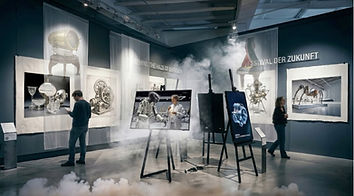
The installation *Behind the Haze of Diffusion*, conceived as a modular laboratory, explores the boundaries of museum authenticity and unfolds across three viewing levels:
Large-format prints on heavy handmade paper attached to basalt-gray walls evoke a sense of tactile authority and recall historical photogravures, yet depict fictional exhibits composed of components from real objects in the collection of the Deutsches Museum.
At the center of the installation, three monitors on black easels present bionic-technical objects that are potentially possible yet not real. The atmospheric level ultimately weaves both worlds together physically: Amid kinetic projections on falling panels of gauze fabric and rock-concert-like floor fog, the algorithmic diffusion process of AI becomes walkable.
Behind the Haze of Diffusion combines the revelation of image-generative biases with a passion for experimentation, creating productive disorientation for anyone seeking hard facts at the 1E9 Festival der Zukunft.
Beverage Bike - Smoothies / Infused Water / Brainfood
Die Techniker
Do/Thu 2.7.26: Smoothies
Smoothies sind beliebte Ganzfruchtgetränke bzw. Fruchtshakes. Im Gegensatz zu herkömmlichen Fruchtsäften, die aus dem gepressten Saft einer Frucht bestehen, wird bei Smoothies die ganze Frucht bis auf die Schale und Kerne verarbeitet. Aus dem Fruchtmark oder Fruchtpüree ergibt sich eine typisch cremige und sämige Konsistenz.
Smoothies are popular whole fruit drinks or fruit shakes. Unlike conventional fruit juices, which consist of the pressed juice of a fruit, smoothies process the whole fruit down to the peel and seeds. The fruit pulp or puree produces a typically creamy and thick consistency.
________________________________________________________________________________________
Fr, 3.7.26: Infused Water
Wasser lässt sich ganz einfach und gezielt mit Obst, Gemüse und Kräutern aufbereiten und verfeinern: Die so entstehenden Getränke sind nicht nur lecker, sondern auch noch gesund. Das Wasser wird dabei – je nach Auswahl der Zutaten – mit Mineralien, Vitaminen und Antioxidantien angereichert.
Water can be easily and specifically prepared and refined with fruit, vegetables and herbs: The resulting beverages are not only delicious, but also healthy. Depending on the choice of ingredients, the water is enriched with minerals, vitamins and antioxidants.
________________________________________________________________________________________
Sa/Sat 4.7.26: Brainfood
Unter „Brainfood“ sind vor allem Lebensmittel zu verstehen, die eine große Menge an Antioxidantien, Vitaminen, Mineralstoffen, Aminosäuren, hochwertigen Fettsäuren und sekundären Pflanzenstoffen beinhalten und möglichst naturbelassen sind. Durch die bedarfsgerechte Zufuhr dieser Mikronährstoffe.
sollen nicht nur das Immunsystem gestärkt, sondern auch die Konzentration und Leistungsfähigkeit am Arbeitsplatz gefördert werden.
"Brainfood" primarily refers to foods that contain a large amount of antioxidants, vitamins, minerals, amino acids, high-quality fatty acids and secondary plant substances and are as natural as possible. The intake of these micronutrients in line with requirements is intended not only to strengthen the immune system, but also to promote concentration and performance at work.
〷◠‿◠〷 This project is part of our festival track "Medicine of the future" funded by the Science Year 2026.

CHITIN_shelter - Bio-based textiles made from marine residual materials
Fraunhofer Institute for Interfacial Engineering and Biotechnology IGB
CHITIN [C8H13NO5]_shelter explores how chitin and chitosan derived from biological marine waste streams can be utilized for textile applications. Instead of linear, petrochemical material logics, it creates an experimental space that brings together material research, textile development, and speculative design to reflect on and investigate: How can biological cycles give rise to new textile materials, body-related applications, and future-oriented design practices?

City in the Cloud – Data on the Ground: Data Soil Installation
GeodatenService der Landeshauptstadt München
The Data Soil is an interactive installation that shows and explains the Digital Twin Munich, a digital representation of the city that is the heart of Munich‘s Smart City approach. The installation was developed in co-creation by the Architekturmuseum der TUM, 3e8 Studio and the City of Munich for the previous architecture exhibition “City in the Cloud – Data on the Ground” in the Pinakothek der Moderne. The exhibition showcased the architecture of data and the resources and infrastructures that are necessary to support the digital cloud.

Digital Fashion Experience Area
Julia Braun
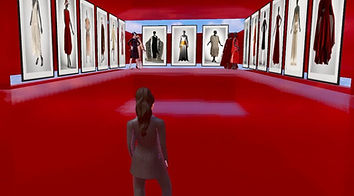
Die Digital Fashion Experience Area bietet Einblicke in die Zukunft von Mode, Kreativität und digitalen Technologien. Besucher können entdecken, wie digitale Kleidungsstücke entstehen, wie Künstliche Intelligenz kreative Prozesse unterstützt und wie Mode in virtuellen Welten präsentiert wird.
Die Experience Area verbindet Ausstellung, Vorträge und immersive Erlebnisse. Gezeigt werden unter anderem Arbeiten aus dem Digital Fashion Contest, digitale Kollektionen, VR-Erlebnisse sowie Einblicke in aktuelle Entwicklungen rund um Digital Fashion, 3D-Technologien und virtuelle Präsentationsformen.
Mehrmals täglich finden geführte Touren und Kurzvorträge statt - alle Termine findet ihr am Stand!
Discover Deep Tech, Startups and Innovation with the EPO
From Patents to Startups: Explore Europe's Innovation Ecosystem
European Patent Office - through the Observatory on Patents and Technology
The European Patent Office (EPO) and its Observatory on Patents and Technology invite visitors to discover and interact with the Deep Tech Finder, a free online platform connecting startups, universities, investors and research organisations across Europe. Through a large interactive touch screen, visitors can explore innovation ecosystems, search for deep tech companies and technologies, and gain a better understanding of the IP world. The booth will also feature videos, topic cards, studies and reports on emerging technologies, including AI in medicine, sustainability and other key innovation trends.

From archaic musical rituals to future medical interventions
JYMMIN
Medical and music-ethnological research at the Max Planck Institute for Human Cognitive and Brain Sciences in Leipzig has led to novel approaches in therapy and prevention. Scientific data demonstrate that an enhanced musical-emotional engagement systematically stimulates hidden resources of the human motor system. This process significantly improves motor performance while positively impacting cognitive and immunological parameters. This presentation provides a comprehensive overview of the JYMMiN research history and its current therapeutic applications.
〷◠‿◠〷 This project is part of our festival track "Medicine of the future" funded by the Science Year 2026.

Fusionsenergie zum Anfassen
Proxima Fusion
Wie entsteht die Energie der Sterne? An unserem Stand zeigen wir, wie Fusionsenergie funktioniert und wie Proxima Fusion das erste kommerzielle Fusionskraftwerk Europas entwickeln will. Entdecke Modelle, Exponate und spannende Einblicke in die Technologie hinter einem der ambitioniertesten Energieprojekte unserer Zeit. Unser Team beantwortet Fragen und erklärt, wie aus Spitzenforschung ein Kraftwerk wird.

Joseph von Fraunhofer Avatar
Fraunhofer IAO X b.ReX
Der hochaufgelöste digitale Avatar zeigt, wie Künstliche Intelligenz und Gaming-Technologien Mensch-Maschine-Interaktionen im Metaverse transformieren können. Lippensynchrone Sprache, natürliche Bewegungen und Reaktion auf Gesten machen den "virtuellen Joseph" täuschend echt. Eingebettet in rekonstruierte 3D-Räume des Klosters Benediktbeuern veranschaulicht er Geschichte und potenzielle Einsatzmöglichkeiten in interaktiven Systemen.

KI Posture-Scan
Die Techniker
Der KI Posture-Scan ist ein innovatives Analysesystem, das mithilfe einer speziellen Videokamera mit Tiefensensor die Körpersilhouette erfasst. Die Messung kann in Alltagsbekleidung durchgeführt werden – je enger die Kleidung anliegt, desto präziser wird die Beurteilung der Körperhaltung. Eine auf künstlicher Intelligenz basierende Software erstellt eine 3D-Abbildung der Körperhaltung und analysiert sie hinsichtlich gesundheitsrelevanter Aspekte und Optimierungspotenzial. Zur Messung sollte anliegende Alltagsbekleidung getragen werden (z. B. Hose mit Hemd oder Bluse). Je enger die Bekleidung, desto präziser die Messung.
The KI Posture-Scan is an innovative analysis system that uses a special video camera with depth sensor to capture the body silhouette. The measurement can be carried out in everyday clothing - the tighter the clothing, the more precise the assessment of posture. Artificial intelligence-based software creates a 3D image of the posture and analyses it with regard to health-related aspects and optimisation potential. Closely fitting everyday clothing should be worn for the measurement (e.g. trousers with a shirt or blouse). The tighter the clothing, the more precise the measurement.
〷◠‿◠〷 This project is part of our festival track "Medicine of the future" funded by the Science Year 2026.

Legerdemain for the Invisible Hand: Alternative Currencies for Alternate Realities
Jonathon Keats
When Adam Smith published "The Wealth of Nations" in 1776, he presented money as a simple "means of exchange", an idea that has dominated economics for two and a half centuries. As capitalism imperils ever more people and socialism fails repeatedly to meet the needs of the masses, it behooves us to ask: Could money do more for us? Festival attendees will have the opportunity to find out by trading in two alternative currencies invented by Jonathon Keats, both of which will be negotiable in the Forum. Internalizing externalities including climate change and individual neediness, the monies might just make the world a better place.

Life in Kinetics
Timo Holzmann
Life in Kinetics is an interactive installation in which machines respond to the presence of visitors through simple vertical movements. Distributed throughout the space, they form a collectively responsive system. The open presentation of the technology makes the processes transparent. A depth camera captures the positions of people in the room and translates this data into the behavior of the machines, creating an experiential space where interaction and resonance between human and machine become directly perceptible.
〷◠‿◠〷 With kind support from the Anita Keijzer Foundation.

Lung Portraits
kennedy+swan
Auch medizinische KI-Modelle sind nicht fehlerfrei. Sie können halluzinieren und liefern mitunter plausible Diagnosen, statt Unsicherheiten einzugestehen. Einer solchen Halluzination widmen sich kennedy+swan: Gemeinsam mit Doktorand*innen des BIFOLD-Instituts konfrontieren sie ein auf Lungenkrebs spezialisiertes KI-Modell mit Aquarellen auf Glas, die mikroskopische Gewebescans imitieren. Was für Menschen wie feine Strukturen echten Lungengewebes aussieht, deutet auch die KI als potenziell krankhaftes Gewebe und erstellt Diagnosen mit verblüffender Sicherheit.
Medical AI models are not error-free. They can hallucinate and sometimes produce plausible diagnoses rather than acknowledge uncertainty. kennedy+swan explore one such hallucination: In collaboration with PhD researchers at the BIFOLD Institute, they confront an AI model specialised in detecting lung cancer with watercolours on glass that imitate microscopic tissue scans. What appears to human observers as delicate structures of real lung tissue is likewise interpreted by the AI as potentially diseased tissue, leading it to generate diagnoses with remarkable confidence.

Magischer Spiegel: Deine 4D Gesundheitsreise - Die Zukunft der Präzisionsmedizin
Fraunhofer-Gesellschaft, Stabsstelle Bürgerformate und Fraunhofer-Verbund Gesundheit
Hallo, ich bin dein Körper … – beziehungsweise dein digitales Spiegelbild. Ich lade dich ein zu einer Reise in dich selbst – und durch die Medizin der Zukunft. Entdecke in diesem Spiel deine Organe und Körperfunktionen. Erfahre mehr über modernste Vorsorge-, Diagnose- und Therapiemöglichkeiten.
Der Schlüssel zur Medizin der Zukunft liegt in 4D: Drugs, Diagnostics, Devices und Data. Fraunhofer-Forschung verknüpft die Arzneimittelentwicklung, Diagnostik, Medizintechnik sowie Datenerhebung und -verarbeitung intelligent miteinander. Wie dadurch eine präzise, individuelle und vor allem bezahlbare medizinische Versorgung möglich wird, zeigt dir dieses Exponat.

Neurospicy Futures of Work – Speculative design for alternative work environments with and by people with ADHD
Fraunhofer Institute for Systems and Innovation Research ISI
What if we reimagined the future of work from a neurodivergent perspective?
This question is explored through four speculative futures co-developed with people with ADHD: rather than offering predictions or solutions, the speculative artifacts invite us to question the present and reflect on possible transformations, drawing on diverse perceptions of time and a shared metaphorical world of food, taste, and texture as a starting point for improving working conditions for all.

Physical AI zum Anziehen: Die smarten Exoskelette von German Bionic
German Bionic
Mit den KI-basierten Exoskeletten von German Bionic erleben Besucherinnen und Besucher, wie tragbare Robotik Menschen bei körperlich anspruchsvollen Tätigkeiten unterstützt. Die intelligenten Systeme analysieren Bewegungen in Echtzeit, geben gezielt Kraftunterstützung beim Heben, Gehen oder Tragen und helfen dabei, Belastungen zu reduzieren. Ein praxisnaher Einblick in die Zukunft von Human Augmentation, Ergonomie und KI im Einsatz für den Menschen.
〷◠‿◠〷 This project is part of our festival track "Medicine of the future" funded by the Science Year 2026.

Playspawn
TNG Tech
Do you have an idea for a browser game? Yes? Do you also want to write the code and generate the assets? No? Then Playspawn is for you! Playspawn uses agentic coding to automate the flow from idea to final game. An AI-agent writes game code using Babylon.JS that runs in the browser. Game assets are generated as needed using external providers such as Elevenlabs, FAL, and Meshy. Using the Playwright MCP integration, the games are automatically tested. wIn this way, creators can generate games by prompting the system with their ideas. Once the game is finished, it can be refined via additional prompts or published to the public game stream. All users can play games on the public stream. New games are accessed easily by swiping to the next game. A selection algorithm ranks the games for the individual user.
Try it out! Get an account today and join the competition. At 18:30, the
creators of today's two most liked games will be awarded a Lego Gameboy.

PortalVision
Robin Forster
The multisensory media installation was designed and implemented as an example for a self-developed textile interface. Thanks to its ease of use, the installation is aimed at visitors of all ages and invites them to interact, discover, and marvel. By pressing into the projection surface, users can dive into the depths of the oceans, discover visions in the flames, or receive distant messages from space. Pressing deeper into the center is enough to navigate effortlessly from one world to the next. The stretchy textile surface of the portal allows for an immediate, haptic understanding of the installation.
〷◠‿◠〷 With kind support from the Anita Keijzer Foundation.

Pupillographie - Schlafanalyse / Sleep Analysis
Die Techniker
Das physiologische Grundprinzip der Pupillographie basiert darauf, dass die Pupillenweite durch das vegetative Nervensystem gesteuert wird. Die Teilnehmenden tragen während der Messung eine Spezialbrille, die über die Messzeit von ca. 5 Minuten den Pupillendurchmesser und seine Schwankungen misst. Auf diese Weise wird der Schläfrigkeitsgrad ermittelt und bewertet.
Wichtig: Zur Messung keine Kontaktlinsen tragen, Brille muss abgenommen werden.
The basic physiological principle of pupillography is based on the fact that pupil width is controlled by the autonomic nervous system. Participants wear special glasses during the measurement, which measure the pupil diameter and its fluctuations over the measurement period of about 5 minutes. In this way, the degree of sleepiness is determined and evaluated.
Important: Do not wear contact lenses for measurement, glasses must be removed.
〷◠‿◠〷 This project is part of our festival track "Medicine of the future" funded by the Science Year 2026.

Somatic Circuits – Interactive experience with neural interfaces
Fraunhofer Institute for Reliability and Microintegration IZM
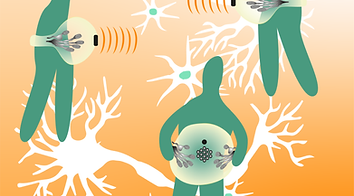
Somatic Circuits is an interactive installation bridging art and science. It draws inspiration from bioelectronic implants developed at Fraunhofer IZM that use ultrasound and electric fields to stimulate and record neural signals, as well as artist Marlot Meyer’s exploration of technology to reveal unseen connections between bodies. The work invites participants to wear inflatable neuron-inspired forms that emit ultrasound and respond to sound, forming a living neural network while deepening bodily awareness, collective connection and public understanding of bioelectronics.
Suit Play
Vincent Moulinet
At this year’s Festival der Zukunft, Caldo Worldwide presents an extension of Vincent Moulinet’s online exhibition, Suit Play. This installation features an automated version of the work, in which a robot dog interacts with the real-time simulation by stomping on a metal-plate controller.
"Daddy Loves You Too." is a real-time simulation in which facets of the self move chaotically, struggling to find their place while being crushed by a restless, hypnotic machine operated by "Daddy." In this collaborative iteration with TNG, a partner-led, value-driven company specializing in high-end information technology, the human foot that once enacted this violence has been replaced by a robot – performing the gesture in our place.

TRP Rover
Deutsches Zentrum für Luft- und Raumfahrt e.V. (DLR)
How will humans and robots work together on the Moon?
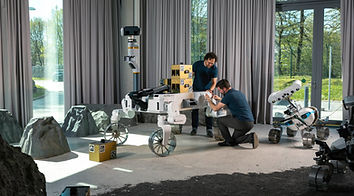
Future lunar missions will go far beyond exploring the Moon’s surface. Astronauts and robots will work side by side to build infrastructure, conduct scientific experiments, and maintain complex technical systems. But which tasks are best suited to humans, which to robots, and how can both work together most effectively?
This interactive exhibit provides insights into the development of future human-robot teams. At its center is a full-scale 1:1 prototype of the TRP rover developed by the Robotics and Mechatronics Center of the DLR. Visitors are invited to explore and test how workstations, tools, and operational procedures for future lunar missions are designed, evaluated, and improved.
The exhibit demonstrates how surprisingly simple and tangible prototyping methods can help shape highly advanced space technologies. Through hands-on interaction, observation, and iterative refinement, researchers develop ergonomic, safe, and user-centered solutions for space exploration. The result is a unique glimpse into the design of future space systems and the collaboration between humans and robots on the Moon – from early concepts to technologies that may one day support real lunar missions.
TRUST. Semester projects by design students at the University of Applied Sciences Munich
Hochschule München, Fakultät für Design
How do we trust what we no longer understand?
Trust feels subjective or personal but works as a socio-technical infrastructure: it shapes how we relate to institutions, devices, systems, procedures, and each other. As technologies get more complex and constantly change and evolve, trust is repeatedly displaced, rebuilt, refused, or quietly lost.
TRUST presents 14 student works showcasing a wide spectrum of topics where trust is essential, and should contribute to the foundations of desirable futures: from AI in medicine to QR-code interfaces, gender bias in healthcare, alcoholism in society, and early-childhood relationships. Visitors look, question, and discuss across analog and digital formats.
〷◠‿◠〷 This project is part of our festival track "Medicine of the future" funded by the Science Year 2026.

The Red Queen Effect
kennedy + swan
In der Videoarbeit The Red Queen Effect melden sich 22 Proband*innen für ein Programm des fiktiven KI Start-ups ALICE an, das mithilfe von Computeranalysen Unsterblichkeit verspricht. In Interviews sprechen sie über Hoffnungen, Ängste und Zweifel gegenüber einer Technologie, die verspricht, den menschlichen Körper besser zu verstehen als wir selbst. Das Video untersucht den Einsatz von KI in der Medizin und fragt, wie bereitwillig wir unsere Körper, Daten und Hoffnungen dem Blick der Maschinen überlassen möchten. Der Titel verweist dabei auf die Rote Königin aus Lewis Carrolls Alice hinter den Spiegeln. In der Evolutionsbiologie beschreibt der Begriff den ständigen Wettlauf, sich immer weiter anpassen zu müssen, um nicht zurückzufallen. So funktioniert die Verbreitung und Bekämpfung von Krankheiten; und ähnlich fühlt es sich heute oft an, den rasanten Entwicklungssprüngen künstlicher Intelligenz gegenüberzustehen.
In the video work The Red Queen Effect, 22 participants apply for a programme by the fictional AI start-up ALICE, which promises immortality through computer-based analysis. In interviews, they speak about hopes, fears and doubts regarding a technology that claims to understand the human body better than we do ourselves. The video examines the use of AI in medicine and asks how willingly we are prepared to surrender our bodies, data and hopes to the gaze of machines. The title refers to the Red Queen from Lewis Carroll’s Through the Looking-Glass. In evolutionary biology, the term describes the constant race of having to keep adapting in order not to fall behind. This is how diseases spread and are fought; and similarly, it often feels today when facing the rapid leaps in the development of artificial intelligence.

What if …? Speculating biomagnetic sensing
Futures Probes
Our body creates tiny electrical currents in the heart, brain, and muscles. Every current also generates a magnetic field. Today, we mainly measure this electrically, but the process is error-prone and complex. That is why researchers have been working for decades on biomagnetic sensing. Infictional future stories, we explore how this technology could change daily life and society. Visitors are invited to get inspired, discuss fictional scenarios, and sort them by how likely, possible, and desirable they seem.
〷◠‿◠〷 This project is part of our festival track "Medicine of the future" funded by the Science Year 2026.

bottom of page